
20 Stories. One Ripple Effect.
Victoria Issack had already done something extraordinary for the children in her community in Zanzibar, Tanzania.
When the local government school closed, she opened her own.
She added classrooms to her home and began welcoming children who needed somewhere to learn, including orphans and children from families living in extreme poverty.
She believed every child deserved an education, regardless of what their parents could afford.
But running a school meant more than teaching lessons.
It meant making sure children had something to eat. It meant finding ways for families to afford school fees. And it meant worrying about something most schools never have to think twice about.
Was the water making her students sick?
One Tap for 110 Children
In 2018, Victoria’s school had 110 students, nine teachers, and just one water tap serving the school and her family.
The water was considered clean by local authorities, but children were still becoming ill after drinking it.
Some missed school because they were sick. Others missed so much time that they eventually dropped out.
Imagine building a school to give children a better future, only to watch something as basic as drinking water threaten their opportunity to learn.
Victoria was already doing everything she could.
Parents who couldn’t afford the full school fees could work in the community garden to help cover the cost. Food grown there helped provide meals for the students. Every day, mothers volunteered their time to cook and tend the garden.
This was a community determined to give its children a chance.
But they needed help making their water safer.
The Day Everything Looked Different
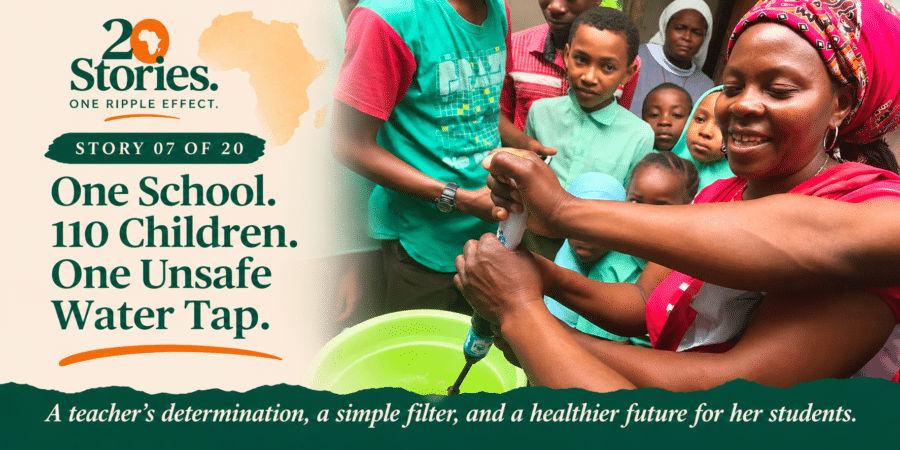
When Sister Toni Temporiti visited Victoria’s school in May 2018, she brought something that would introduce a new possibility.
A water filter.
She demonstrated how contaminated water could pass through the filter and become safer to drink.
Then she did something the children hadn’t expected.
She drank the filtered water herself.
The students clapped.
Victoria and the teachers tried it too. Soon, the children wanted to drink the filtered water.
For a school where unsafe water had been a constant concern, the demonstration offered hope that things could be different.
And through MPA’s Clean Water Program, Victoria and her community had a pathway to obtain filters through microfinancing.
More Than Water
For Victoria, clean water wasn’t simply about having something safe to drink.
It was about children staying healthy enough to attend class.
It was about teachers spending more time teaching and less time worrying about illness.
And it was about protecting the opportunity she had worked so hard to create.
Because a child cannot fully benefit from an education if something as basic as drinking water keeps them out of the classroom.
Victoria’s story reminds us that the challenges of poverty are connected. Education, health, nutrition, and opportunity all depend on one another.
For 20 years, Microfinancing Partners in Africa has worked to address those challenges through sustainable solutions that help communities build stronger futures.
Sometimes, that begins with a loan.
Sometimes, it begins with a cow.
And sometimes, it begins with a teacher who refuses to give up on her students—and a water filter that offers them a healthier tomorrow.
Help make the next opportunity possible. Give the gift of clean water today.
Story 07 of 20 | 20 Stories. One Ripple Effect.